Festive season sparks strong performance despite rains, regulations, and rising scrutiny
Once again, India’s fireworks capital, Sivakasi, has translated the nation’s festive fervour into fireworks sales that are expected to soar to a whopping ₹6,000 crore for the Deepavali season 2025. Industry stakeholders estimate that the expected sales are similar to last year, and that is a strong sign of durability for the industry, which is still having to contend with threats from the weather to government environmental regulations.
Steady Season
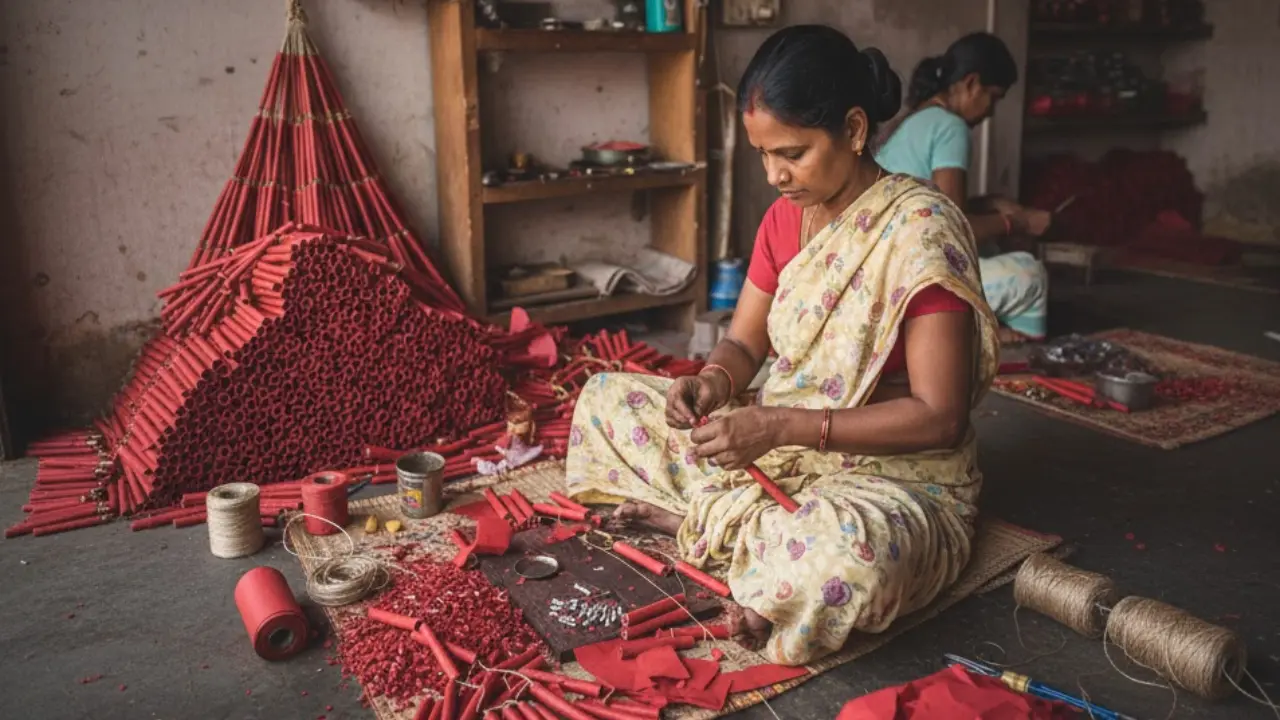
Most of the country’s fireworks come from Sivakasi in Tamil Nadu’s Virudhunagar district. The approach of the Deepavali festival transforms the town into a busy place where factories are working overtime, churning out products 24 hours a day, using trucks to rush product shipment every minute around the country.
According to the Indian Fireworks Manufacturers Association (IFMA), this year’s sales figure of ₹6,000 crore nearly matches that of 2024. Though the growth rate has remained flat, manufacturers see stability as a success in itself, given recent hurdles faced by the industry.
T. Kannan, General Secretary of IFMA, stated that the lifting of the blanket ban on firecrackers in Delhi-NCR is likely to fuel demand in the coming years. “Delhi alone accounted for around 15% of our sales before the restrictions. Now that the market is reopening, we expect stronger orders in 2026,” he said.
Fancy Crackers Lead the Boom
The 2025 season saw a notable rise in demand for fancy and decorative crackers, those with vibrant lights, sound variations, and multi-shot effects.
“These high-value products drove much of the revenue,” said Ganesan Panjurajan, President of the Tamil Nadu Fireworks and Amorces Manufacturers Association (TNFAMA). “Consumers are looking for variety and visual appeal rather than just sound. The shift toward premium fireworks is evident across states.”
Industry insiders also highlighted that harmful emissions recorded in certain cities were not due to Indian-made crackers, but because of illegal Chinese imports entering through grey markets. “Domestic manufacturers have shifted to safer, greener compositions,” Panjurajan added. “But unregulated imports continue to harm both the environment and our industry.”
Weather Woes and Production Challenges
Despite the encouraging numbers, the industry’s production lines faced significant hurdles this year.
Unseasonal rains and periodic licence suspensions at a few factories led to a temporary slowdown in output. Workers also reported delays in drying gunpowder and assembling fireworks due to prolonged humidity.
However, manufacturers ensured that these obstacles did not disrupt market supply. By adjusting work shifts and expediting packaging once conditions improved, they managed to maintain steady deliveries across states.
Price stability was another key achievement. Even with increased raw material costs and logistical expenses, prices remained largely unchanged from last year, a move welcomed by consumers and retailers alike.
15,000 Licensed Retailers Keep the Spark Alive
According to the Federation of Tamil Nadu Fireworks Traders, around 15,000 licensed outlets operated across the state this year, ensuring safe and legal distribution. Nearly 90% of the available stock was sold out before Deepavali week.
However, some coastal districts such as Chennai, Nagapattinam, and Mayiladuthurai witnessed slightly lower sales due to continuous rainfall during the festival period. “Had the weather been better, we might have even surpassed last year’s sales,” said N. Elangovan, Secretary of the Federation.
Economic Lifeline for Thousands
For Sivakasi and its neighbouring towns, the fireworks industry is more than a festive business; it’s a way of life.
Over 8 lakh workers, directly and indirectly, depend on this trade for their livelihood. From factory labourers and packaging units to transporters and small shop owners, the ripple effect of Deepavali sales sustains the region’s economy year-round.
Beyond employment, the fireworks trade also supports several ancillary industries such as printing, paperboard, aluminium powder, and packaging materials, making Sivakasi one of the most vibrant industrial clusters in South India.